
Let’s Talk Neurofeedback
If you’ve never heard of neurofeedback, you’re not alone. Many people are familiar with therapy, medication, mindfulness, and exercise as ways to support mental health. Neurofeedback is less widely known, but it has been helping people support brain and nervous system regulation for decades.
At The Lotus Center, we’re excited to be introducing Infra-Low Frequency Neurofeedback (ILF Neurofeedback) this August.
So what exactly is it?
What Is Neurofeedback?
Neurofeedback is a non-invasive approach that helps the brain receive information about its own activity.
Using sensors placed on the scalp, the system monitors brain activity and provides real-time feedback through visual and auditory cues. This feedback allows the brain to recognize patterns in its own functioning and make adjustments over time.
Unlike many people assume, neurofeedback is not mind control, brain stimulation, or something that requires conscious effort. You don’t have to “do” anything. The brain does the learning on its own.
What Makes ILF Neurofeedback Different?
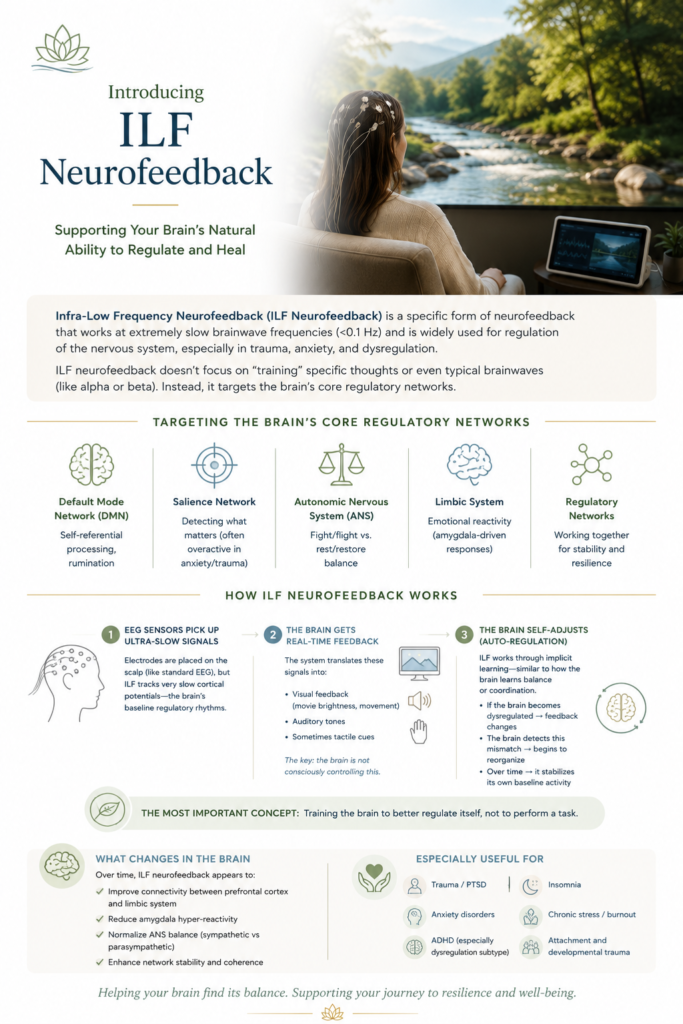
Infra-Low Frequency Neurofeedback (ILF Neurofeedback) focuses on extremely slow brainwave activity that is involved in the brain’s core regulatory systems.
Rather than training a person to produce specific brainwaves, ILF Neurofeedback supports the brain’s ability to regulate itself more effectively.
This includes networks involved in:
- Stress regulation
- Emotional regulation
- Attention and focus
- Sleep
- Nervous system balance
- Resilience and recovery
Because of this, ILF Neurofeedback is often used to support individuals experiencing anxiety, chronic stress, trauma, sleep concerns, emotional reactivity, ADHD, and nervous system dysregulation.
How Does ILF Neurofeedback Work?
During a session, sensors are placed on the scalp to measure brain activity. The system translates this information into visual and auditory feedback, such as changes in a movie, animation, or sound. The important thing to understand is that the brain is not consciously trying to control the feedback.
Instead, the brain naturally detects changes and begins making subtle adjustments through a process called implicit learning—the same type of learning involved in developing balance, coordination, and other automatic skills.
Over time, this process may help the brain become more flexible, stable, and resilient.
What Does a Session Feel Like?
One of the most common questions people ask is:
“Will I feel anything?”
Most people find ILF Neurofeedback sessions relaxing and comfortable. Many simply sit back and watch a screen while the system provides feedback in the background.
Some individuals notice changes immediately. Others notice gradual improvements over time. Every brain is unique, which is why the experience can look different from person to person.
Who Might Benefit from ILF Neurofeedback?
ILF Neurofeedback may be worth exploring if you experience:
- Anxiety
- Chronic stress
- Burnout
- Emotional overwhelm
- Difficulty focusing
- Sleep challenges
- Feeling “stuck” in patterns that are difficult to change
- Trauma-related symptoms
- Nervous system dysregulation
Many people seek neurofeedback because they feel like they understand their challenges intellectually but still struggle to feel different.
Neurofeedback offers another pathway for supporting change.
A Different Way to Think About Mental Health
For many years, mental health conversations focused primarily on thoughts, behaviors, and emotions. Today, we increasingly understand the important role the brain and nervous system play in overall wellbeing. Neurofeedback is not meant to replace therapy, mindfulness, medication, or other forms of support. Instead, it adds another layer.
Interested in Learning More?
The Lotus Center will begin offering ILF Neurofeedback in August. If you’re curious about whether neurofeedback may be a good fit for you, we invite you to join our interest list and schedule a complimentary 15-minute consultation.
This brief conversation is an opportunity to learn more about ILF Neurofeedback, ask questions, and explore whether it may support your goals. Call The Lotus Center at 385-272-4292 or visit our website to learn more and reserve your consultation.